
Darlington Pair (High Current)
Darlington Pair (High Current) is a runnable microcontroller simulation example on SensBench — open the wired circuit, inspect the code, and compile real firmware in your browser, no install needed. Last updated Aug 14, 2026.
FREE SIMULATOR EXAMPLE · ADVANCED
Darlington Pair (High Current)
This example drives an LED through a Darlington pair on the Arduino Uno — two cascaded NPNs with beta-squared current gain — and fades it with PWM so you can watch the proportional amplification in action. The high-current switch for heavy loads from tiny base currents.
| Board | Arduino Uno (ATmega328P) + analog SPICE circuit |
|---|---|
| Difficulty | advanced |
| Category | circuits |
| Libraries | None — just the Arduino core |
| Runs in | Sensbench browser simulator — free, no account |
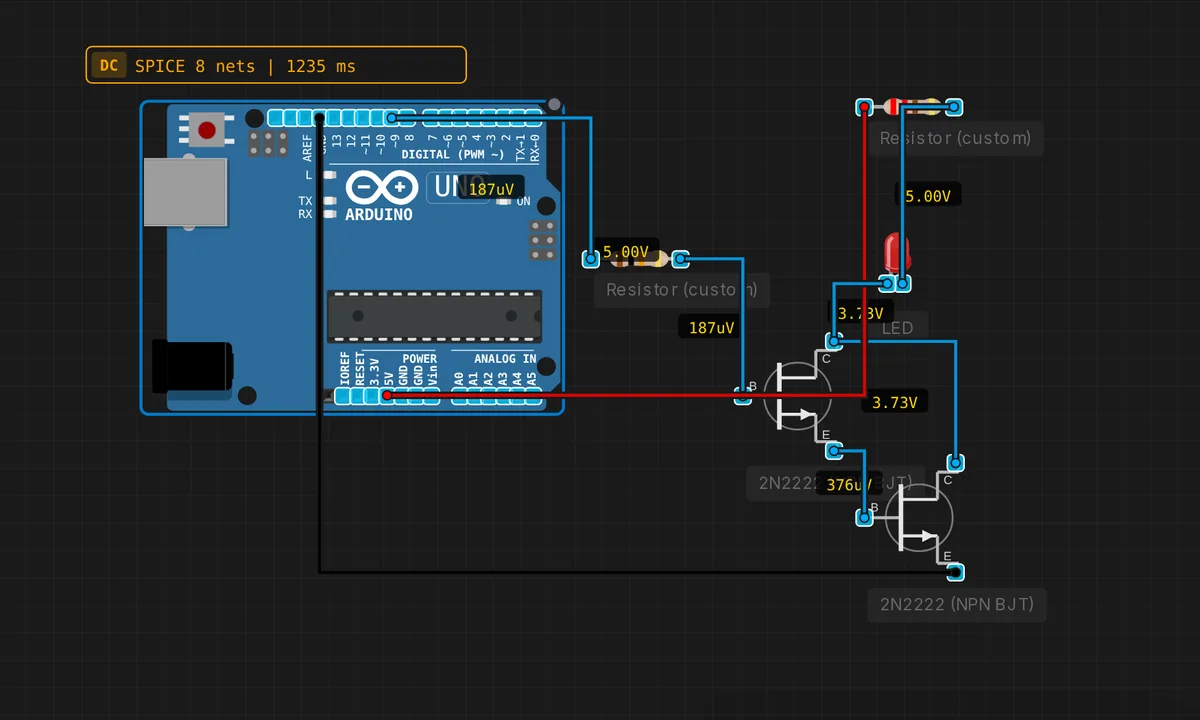
The exact circuit you get when you open this example — already wired, ready to run.
The sketch
// Darlington pair — beta-squared gain drives LED from tiny base current.
// Fade in/out so you can SEE the Darlington proportionally amplifying.
void setup() { pinMode(9, OUTPUT); }
void loop() {
  for (int d = 0; d <= 255; d += 5) { analogWrite(9, d); delay(15); }
  for (int d = 255; d >= 0; d -= 5) { analogWrite(9, d); delay(15); }
}
How it works
Two NPN transistors are wired so the first’s emitter feeds the second’s base — the collector current of Q1 becomes the base current of Q2, and the total gain is the product of the two betas. The LED sits in Q2’s collector, and the Arduino’s pin 9 drives Q1’s base through the usual resistor.
The sketch fades the LED with PWM in 5-unit steps, 15 ms per step. The comment says why the fade exists: it makes the proportional amplification visible — as the PWM duty ramps, the LED brightness follows smoothly, showing the Darlington faithfully tracking its tiny base signal across the whole range.
Before you build it for real
The Darlington’s double Vbe drop (~1.4 V) is the real-world cost: driven from a 3.3 V MCU, the base voltage headroom collapses, and the pair may never fully saturate — the LED runs dim and Q2 gets warm. The beta-squared gain varies wildly with temperature and between parts, so the base resistor must be sized for worst-case gain or the pair overdrives. And the PWM fade makes the thermal picture worse than DC: real Darlingtons dissipate most heat during the linear transition edges, and a fast PWM train keeps the pair in transition more often — attach a heat sink for anything near the current limit.
Get the parts
Related examples
FAQ
Why cascade two transistors?
Each transistor multiplies the current by its gain (beta). Two in cascade multiply again — beta-squared, often 10000x or more. A microamp of base current can switch hundreds of milliamps. One transistor gives beta; a Darlington gives beta², which is what tiny base currents need.
What is the cost of the Darlington arrangement?
Two junction drops instead of one: the base needs about 1.4 V to turn on (0.7 V per junction), and the saturation voltage is higher. On a 5 V rail that is fine; on a 3.3 V rail it eats nearly half the headroom. The Darlington is also slower to switch, though that does not matter at LED fade rates.