
Parallel Resistors
Parallel Resistors is a runnable microcontroller simulation example on SensBench — open the wired circuit, inspect the code, and compile real firmware in your browser, no install needed. Last updated Aug 14, 2026.
FREE SIMULATOR EXAMPLE · BEGINNER
Parallel Resistors
This example measures the equivalent resistance of three parallel 10 kOhm resistors using a voltage divider on the Arduino Uno — the parallel-resistor formula verified live. The junction reads 1.25 V, matching the math in the comments.
| Board | Arduino Uno (ATmega328P) + analog SPICE circuit |
|---|---|
| Difficulty | beginner |
| Category | circuits |
| Libraries | None — just the Arduino core |
| Runs in | Sensbench browser simulator — free, no account |
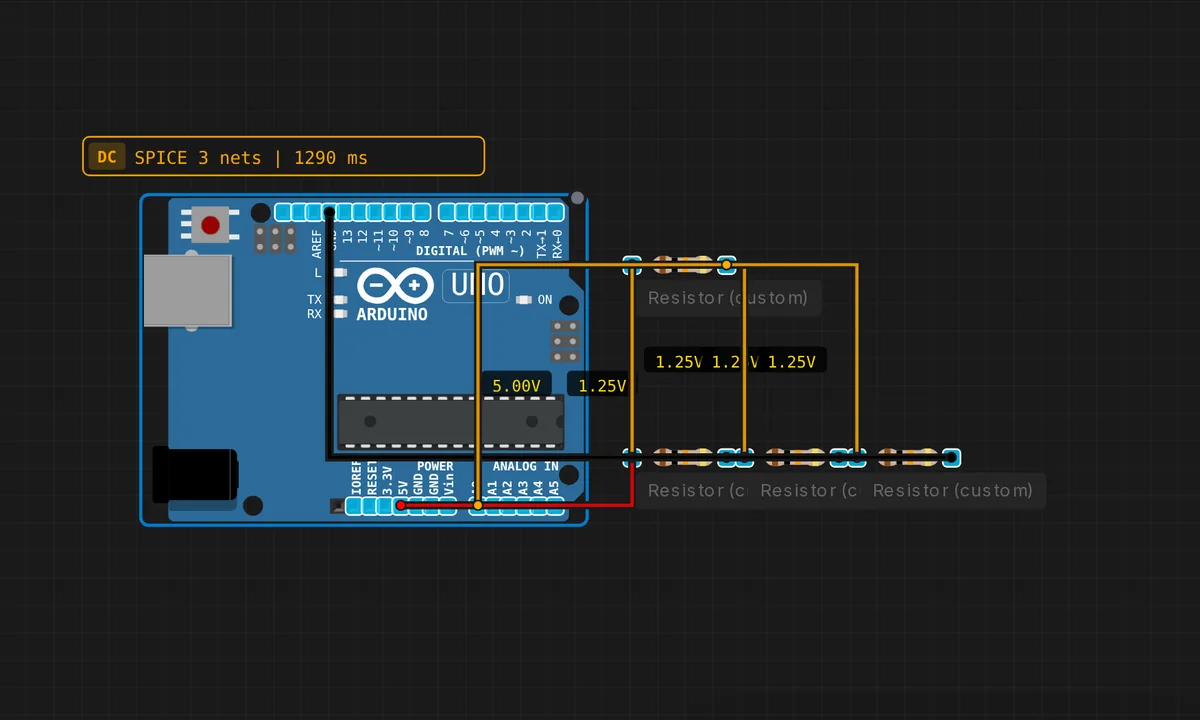
The exact circuit you get when you open this example — already wired, ready to run.
The sketch
// Parallel Resistors — measure equivalent R via voltage divider
// R_series = 10k, R_parallel = 1/(1/10k + 1/10k + 1/10k) = 3.33k
// V_out = 5 * R_par / (R_ser + R_par) = 5 * 3.33 / 13.33 = 1.25V
void setup() { Serial.begin(9600); }
void loop() {
  float v = analogRead(A0) * 5.0 / 1023.0;
  Serial.print("V = "); Serial.println(v, 3);
  delay(500);
}
How it works
The circuit is a divider built from a 10 kOhm series resistor and a parallel bank of three 10 kOhm resistors. The bank’s equivalent resistance is 1/(1/R1 + 1/R2 + 1/R3) = 3.33 kOhm, so the junction sits at 5 × 3.33/(10 + 3.33) = 1.25 V.
The sketch reads the junction on A0 and prints the voltage every 500 ms. The comment walks the full math — the parallel formula, then the divider formula — so the printed reading is a live verification of both. Remove a resistor in the simulator and the voltage changes, demonstrating the formula in action.
The 500 ms cadence keeps the readout fresh while leaving the math visible in the comment block above the code.
Before you build it for real
The measurement inherits the divider’s tolerance chain: the series resistor and all three parallel resistors carry their own tolerances, and the voltage reading compounds them. The 10-bit ADC also quantizes to ~5 mV per count, so tiny differences between resistor values vanish into the noise floor. On a real bench, the parallel bank halves the total power per resistor — three resistors each dissipate a third of the heat — which is the actual engineering reason to parallel resistors rather than use one big one. And breadboard contact resistance (50-100 mOhm per insertion) is negligible here but matters in low-value parallel banks.
Get the parts
Related examples
FAQ
Why do parallel resistors always measure lower than the smallest one?
Each resistor adds a second path for current. More paths means less total resistance — the equivalent is always less than the smallest member. Three 10 kOhm resistors in parallel give 10/3 = 3.33 kOhm, exactly what the comment predicts.
Why would you ever wire resistors in parallel instead of using one?
Power handling and precision. Two 1% resistors in parallel give the same value as one 0.5% resistor at lower cost, and parallel resistors split the current and thus the heat — the standard trick when a single resistor would exceed its power rating.